“Resume” and “CV” are often used as if they mean the same thing, and in much of the world they do. In other places they are two different documents, and sending the wrong one can make an application look out of place. This guide explains the difference, where each word is used, and how to decide what to send.
The short answer
A resume is a short, targeted summary of your experience, written for one kind of job. A CV (curriculum vitae, Latin for “course of life”) can mean either the same short document, or a longer, complete record of your career, depending on where you are.
- In the United States and Canada, a resume is what you send for almost every job. A CV there means a long academic or research document.
- In the UK, Ireland, most of Europe, South Asia, the Gulf, Africa and New Zealand, “CV” is the everyday word for the short job-application document that Americans call a resume.
- In Australia, both words are used, often interchangeably, for the same application document.
So if a UK employer asks for your CV, they almost always want the two-page document a US employer would call a resume. If a US university asks for your CV, they want the full academic version.
Resume vs CV at a glance
- Used for: a resume and a UK/Europe-style CV are both used for most job applications; an academic CV is for academic, research, teaching and some medical roles.
- Typical length: a resume is one page, or two with long experience; a UK/Europe-style CV is usually two pages; an academic CV runs as long as your record needs, often several pages.
- Tailored to each job: yes for a resume and a job-application CV; only partly for an academic CV, where the record stays complete and the emphasis changes.
- Photo: leave it out of a US or Canadian resume; out in the UK and Ireland but common in parts of Europe; usually left out of an academic CV.
- Key sections: summary, experience, skills and education for a resume or job-application CV; education, publications, research, teaching, grants and conferences for an academic CV.
The rule of thumb: the job-application document is short and tailored whatever it is called; only the academic CV is long and exhaustive.
What goes in a resume (or a job-application CV)
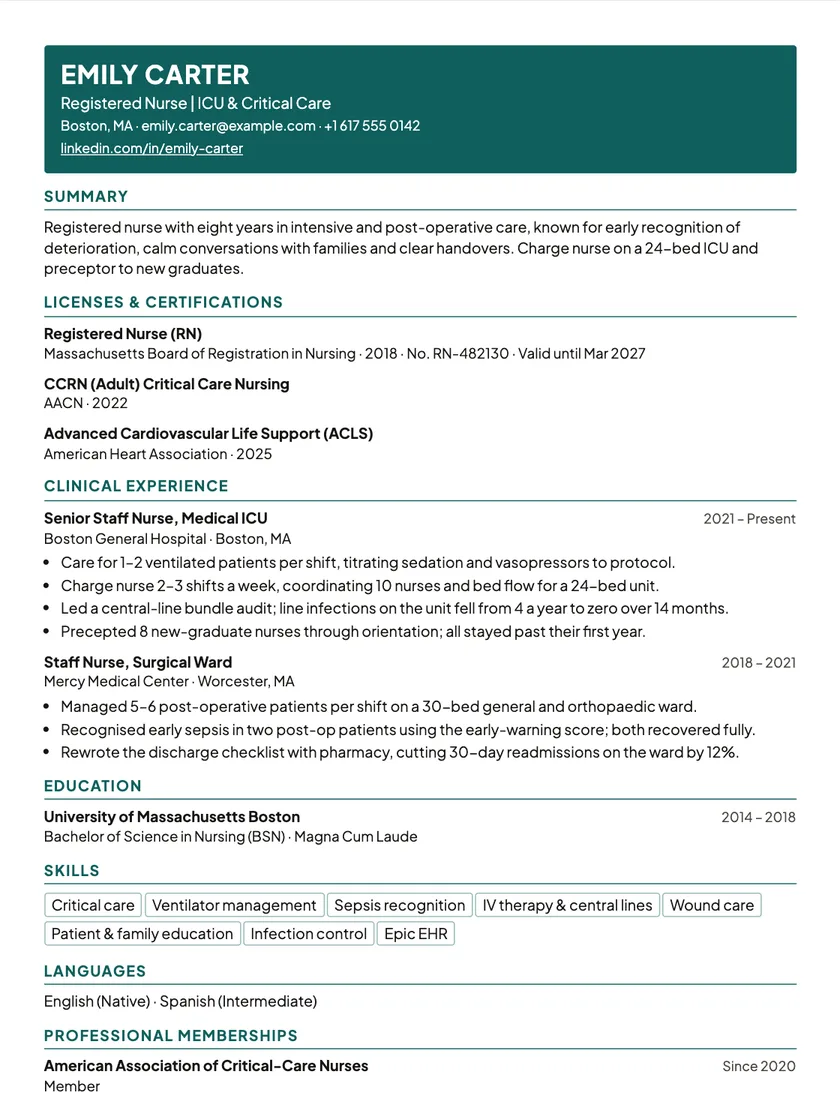
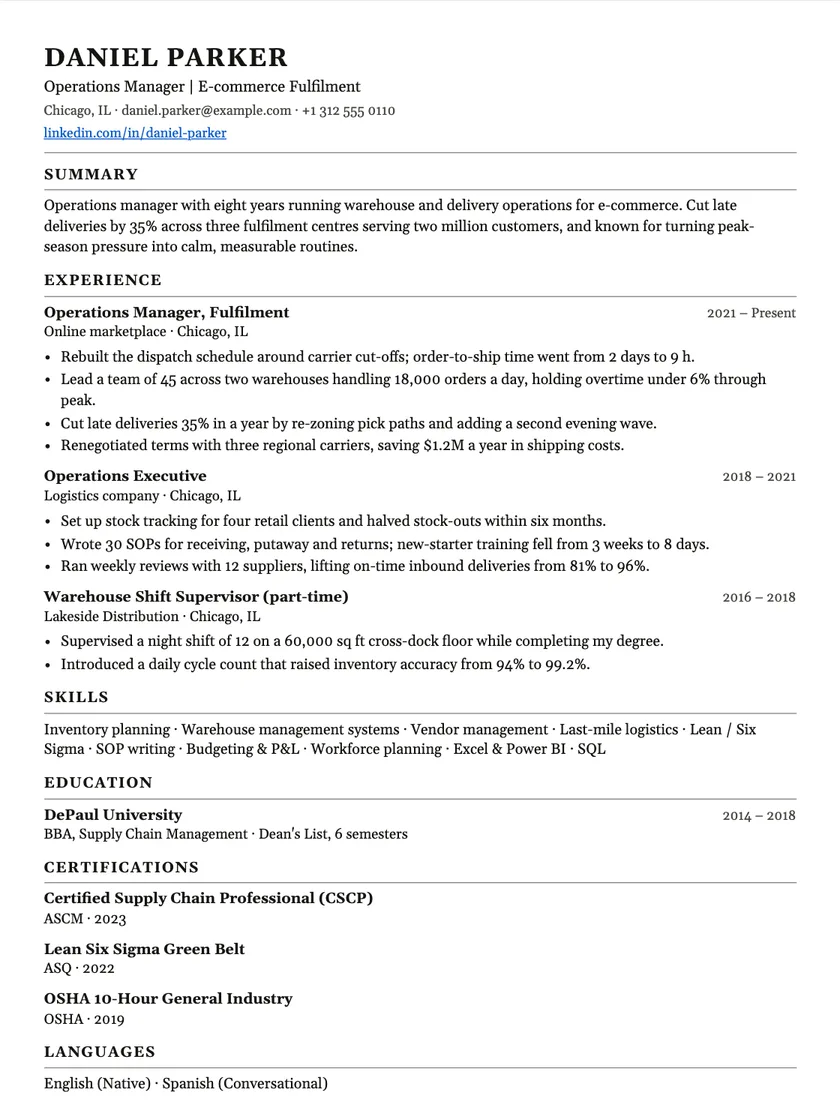
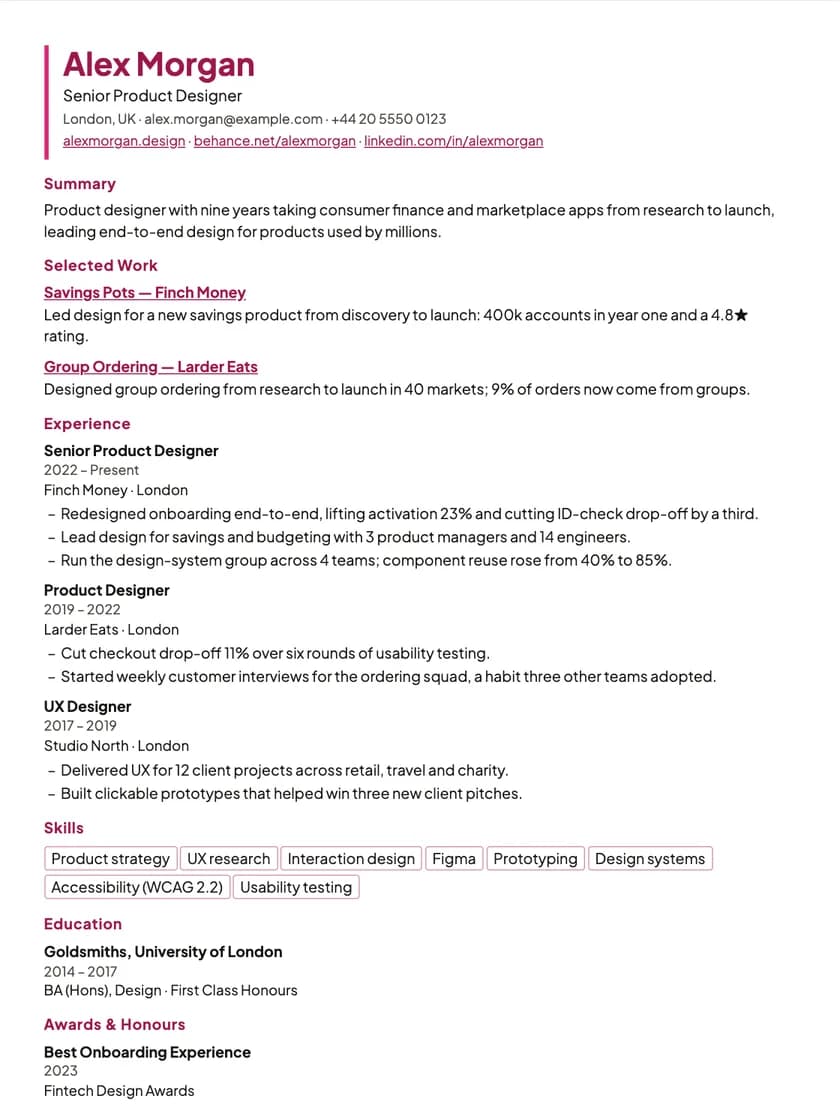
Whether it is called a resume or a CV, the document you send for most jobs has the same core sections:
- Name and contact details: email, phone, city and country, and a LinkedIn or portfolio link if your field uses one. A full street address is rarely needed.
- A headline and short summary: two to four lines on what you do, your specialism and one credible result.
- Experience: your roles in reverse chronological order, each with a few bullets about what you achieved, not only what you were responsible for.
- Skills: the tools, methods and qualifications that matter for the role, ideally backed up by your experience.
- Education, plus certifications, projects, languages or volunteering where they are relevant.
Because it is short, it is selective. You include what makes the case for this job and leave out what does not. Our guide on tailoring a resume to a job description shows how to make those choices.
What goes in an academic CV
An academic CV is a full record rather than a pitch. You do not trim it to one page, and you generally do not leave out earlier work. Typical sections include:
- Education, including thesis titles and supervisors
- Academic appointments and research positions
- Publications, listed in a consistent citation style
- Conference presentations and invited talks
- Grants, fellowships, awards and honours
- Teaching experience and supervision
- Professional service, such as reviewing or committee work
- Referees, where the field expects them
You would send one for a faculty or postdoctoral position, a PhD or research programme, a fellowship or a grant application. Some medical and scientific roles outside universities ask for one too. If the posting says “CV” and it is in the US or Canada, assume they mean this version.
Regional norms: photos and personal details
What counts as normal personal information varies a lot by country, and it is worth getting right.
- United States, Canada, UK and Ireland: leave out the photo, date of birth, marital status and nationality. Employers in these countries generally prefer not to receive them, partly because of anti-discrimination rules.
- Parts of continental Europe, for example Germany, Austria and Switzerland: a professional photo has traditionally been common, though it is becoming more optional. Some applicants also include date of birth or nationality.
- South Asia and the Gulf, including Bangladesh, India, Pakistan, the UAE and Saudi Arabia: a photo and personal details such as nationality, visa status and notice period are often expected, and a languages section and references are common.
When in doubt, look at what the posting asks for and what is usual for the company. A multinational hiring in Dubai may follow different norms from a local firm, and a job ad that asks for “no photos” means exactly that.
How long should it be?
For a resume or job-application CV, aim for one page early in your career and up to two pages with more experience. Senior candidates sometimes go to three, but every line has to earn its place. An academic CV has no fixed limit; a new PhD might have three pages and an established professor twenty.
Which one should you send?
Ask three questions:
- What does the posting ask for? If it specifies a format, length or file type, follow it.
- Where is the job? A US or Canadian employer wants a resume. A UK, European, South Asian or Gulf employer saying “CV” usually wants the same short document, adjusted for local norms.
- Is the job academic or research-based? If yes, send a full academic CV, wherever it is.
Whatever you send, the formatting advice is the same: one clear column, standard headings and real text, so that the employer’s applicant tracking system reads it properly. Our ATS-friendly resume guide covers that in detail.
How ResumHero handles both
ResumHero is a resume builder and a CV builder at the same time, because the difference is mostly about convention, not content. Your experience, skills, projects, education and certifications live in one career profile, and each resume or CV you create draws from it. So you can keep a two-page CV for UK applications and a one-page resume for a US role without retyping anything.
The templates cover the main conventions, including:
- Academic CV, for academic, research and teaching applications where a CV is expected to run several pages.
- International CV, with an optional photo slot, for Europe and other markets where a photo is customary.
- South Asia & Gulf CV, with a photo slot and room for nationality, visa status and notice period, plus suggested Languages and References sections.
Templates without a photo slot simply leave it out, which is what you want for most US and UK applications. Switching template never changes your content, and every version exports as PDF or Word. If you have an existing resume or CV, you can import the PDF or Word file into your profile and review what was found before anything is saved. See the full list of features, or start on the resume builder.